
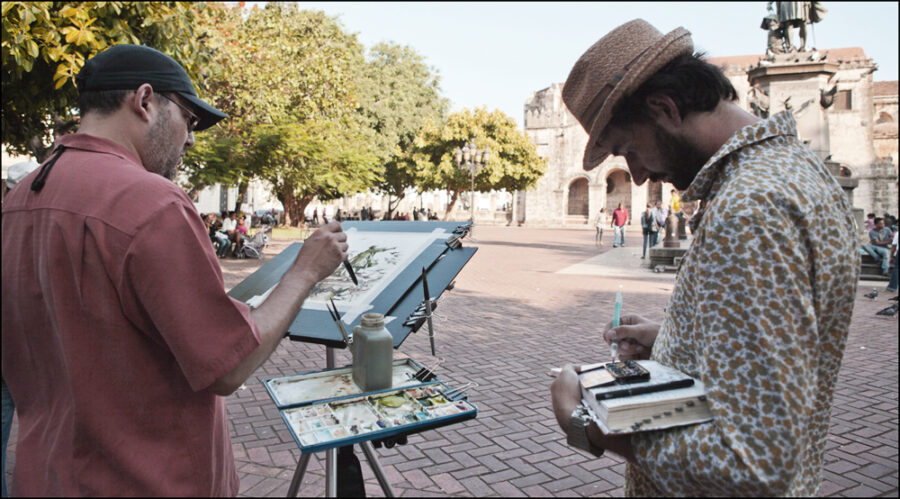
Urban sketching is drawing on location from direct observation. The city keeps moving while you work: people cross the street, buses hide buildings, light changes and cafés fill up.
You do not need to record everything. Choose what makes the place feel specific and let the rest stay simple.
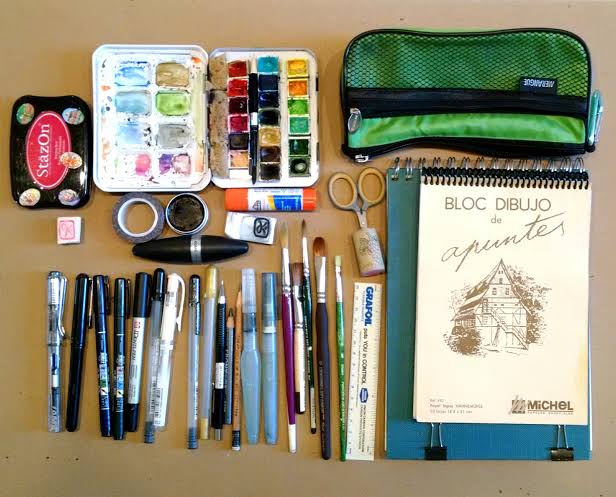
Your materials should let you start drawing in less than a minute.
Sketchbook
Pencil or mechanical pencil
Fineliner or fountain pen
Brush pen or marker
Kneaded eraser if you use one
Small watercolor palette
Water brush or travel brush
Two small water containers
Limited colored pencils or markers
Cloth or tissues
Small clips
Foldable stool if useful
Water bottle
Hat and weather protection
Portable charger
Find one clear reason to stop. It might be a façade, a corner of light, a row of signs, a café table or the way people move through a square.
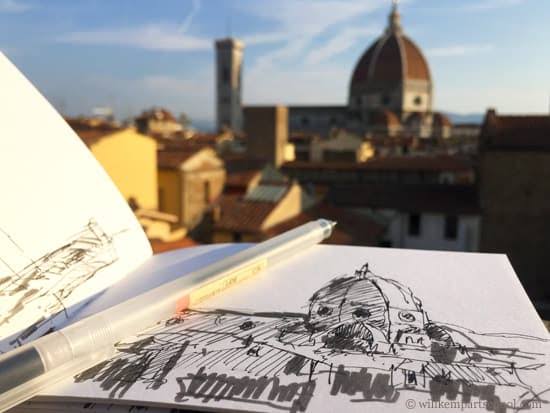
Before drawing details, decide what enters the page and what stays outside it. A strong crop often does more than a complicated composition.
Use the sketchbook edges as part of the design.
Perspective helps, but it should serve the drawing rather than stop it.
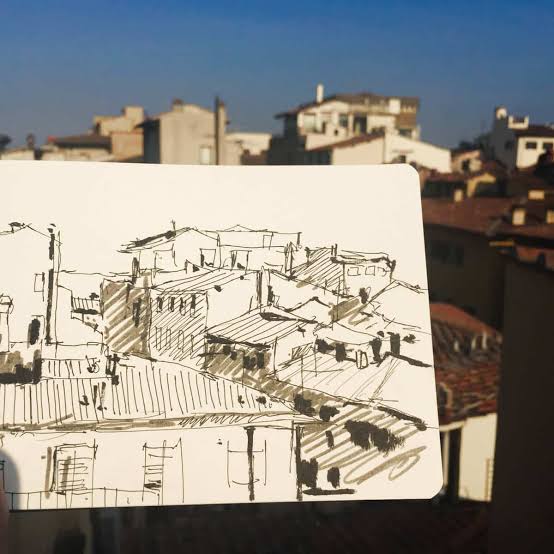
Look first at rooflines, street edges and the main direction of façades. Compare their slopes before measuring windows.
Doors, lampposts and building corners give you stable references while the rest of the scene becomes more complex.
You rarely need every window. Establish the rhythm, then suggest the rest with fewer marks.
Do not wait for someone to hold still. Begin with gesture: the tilt of the torso, the direction of the legs, the weight of the body.
For moving figures, draw in layers. One person gives you a head and shoulders, the next gives you legs, another gives you a coat or bag. The final figure can be a collection of observations.
Keep faces minimal unless they are the point of the sketch.
Line: vary pressure and speed. Let some edges disappear.
Value: a few dark shapes can organize an entire page. Look for doorways, cast shadows, trees and figures that connect.
Color: use it selectively. A limited palette often feels more like a place than trying to match every local color.
White paper: leave some of it untouched. Empty space gives the sketch air.
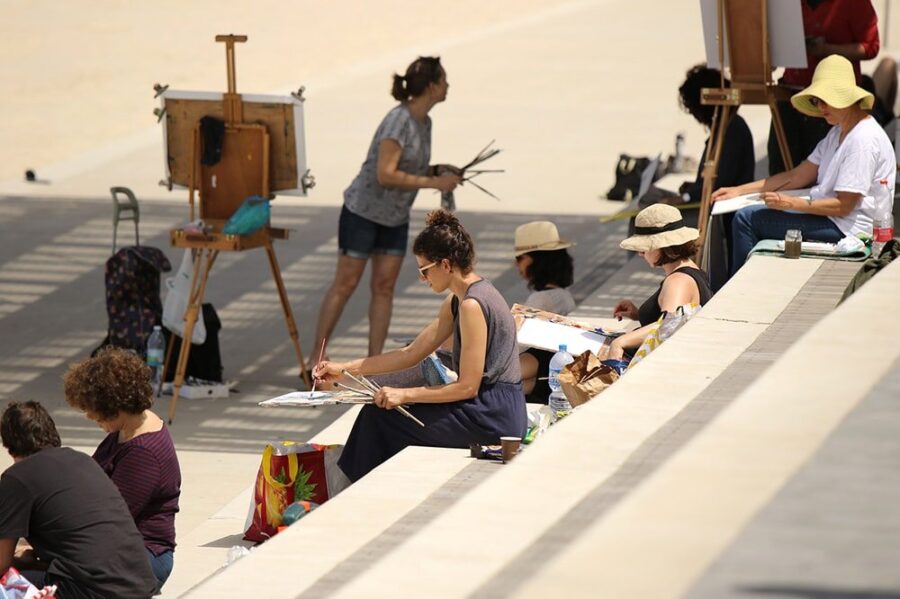
Urban sketching has a strong community tradition. Group sketching gives you a destination, a time limit and other interpretations of the same place.
Be considerate of pavements, cafés, private entrances and other people using the space. When drawing people, stay respectful and discreet.
Urban Sketchers is the main international nonprofit community devoted to drawing on location, with local chapters, workshops and international events.
□ Sketchbook
□ Pencil / pen / brush pen
□ Small color kit if needed
□ Clips
□ Water and tissues
□ Weather protection
□ A place to sit or stand safely
Before you leave: add the date and place. A sketchbook becomes more valuable when it remembers where it was made.
Observe, choose, simplify and keep moving.
Books to support your practice, with links to publishers or the author’s official book list.
Shari Blaukopf, Stephanie Bower & Gabriel Campanario
A broad reference combining architecture, perspective, people, motion and color for location sketching.
Stephanie Bower
Clear, practical perspective methods designed specifically for drawing streets, buildings and spaces on location.
Shari Blaukopf
A concise guide to color choices, mixing and watercolor handling for sketches made on location.
Gabriel Campanario
A field-oriented guide to buildings, streets and city spaces by the founder of Urban Sketchers.
Stephanie Bower
Portable, practical advice for composition, perspective, line, light and common problems encountered while sketching outdoors.
Eliot Goldfinger
Animal anatomy
A reference for understanding animal skeletons, muscles and surface forms when drawing animals.
Juliette Aristides
Drawing practice
A workbook for building drawing skills through regular practice.
FIELD KIT
Explore pocket sketching kits, pencils and compact watercolor easels for drawing around town.